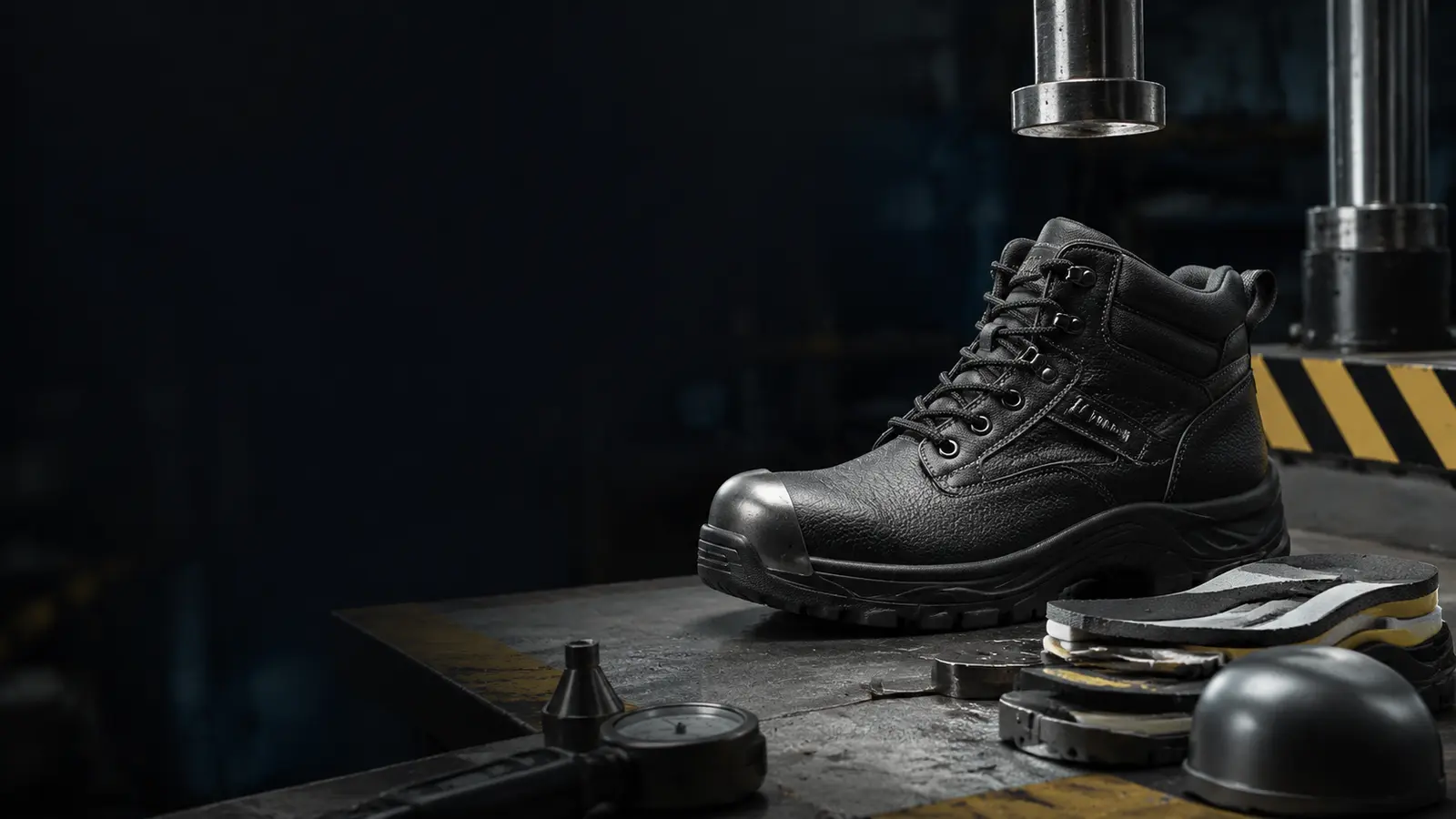
Every VITOSAFE datasheet carries a class like S1P or S3. For an importer or distributor, these letters decide which models you can sell into which customers — yet they are often the least-understood part of the catalogue. This guide explains the EN ISO 20345 class system in plain language.
EN ISO 20345 is the European standard for safety footwear: footwear that includes a toecap protecting against a 200-joule impact — roughly a 20 kg weight dropped from about one metre.
The Five Class Marks
Each class adds requirements on top of the previous one. The fastest way to read them:
| Class | Toe cap 200 J | What it adds | Typical use |
|---|---|---|---|
| SB | ✓ | Basic certified protection only; closed heel area | Light indoor duty, price-driven programmes |
| S1 | ✓ | Antistatic properties + energy-absorbing heel | Dry indoor factories and workshops |
| S1P | ✓ | S1 + penetration-resistant midsole (nail plate) | Logistics, manufacturing — the B2B best-seller |
| S2 | ✓ | S1 + water-resistant upper | Outdoor work without nail risk |
| S3 | ✓ | S2 + nail plate + cleated (lugged) outsole | Construction, mining, agriculture, wet sites |
Note: a 2022 revision of EN ISO 20345 updated marking conventions. Confirm with the factory which revision each datasheet follows before publishing claims. †
Markings You’ll See After The Class
- A — antistatic footwear (dissipates static charges)
- E — energy absorption in the heel seat
- P — penetration-resistant midsole
- WR / WRU — water-resistant upper or full water penetration resistance
- HRO — heat-resistant outsole (contact heat ~300 °C)
- CI — cold insulation of the sole complex
- CR — cut-resistant upper
- M — metatarsal protection
- ESD — electrostatic discharge controlled (stricter than A; for electronics)
- SRC — slip resistance tested on both ceramic-with-detergent and steel-with-glycerol surfaces
Matching A Class To Your Market
Specify by hazard, not by habit: wet-season sites push toward S3, electronics assembly toward ESD variants, and price-driven programmes often start at SB/S1P. When in doubt, send us the working conditions and destination market — the export team will shortlist suitable models from the catalogue.
Filter the catalogue, add models to your enquiry list, and receive per-model datasheets with your quotation.